Saturday, September 09, 2006

Cancer genetic discovery breaks new ground

It is only a matter of time until genetic discoveries help in the prevention of disease - predictive health.

According to a study published in Science and covered by Healthday, researchers have sequenced the genetic "blueprints" of two major cancer killers - breast and colon cancer.

Identifying nearly 200 genes thought responsible for these diseases, the work gives researchers new insight into these malignancies and lays the foundation for the gene-targeted therapies that may one day cure them."Only by understanding this blueprint of cancer will we be fully able to understand the mechanism of what makes a cancer a cancer and to think about strategies for diagnosis, prevention and therapy," explained Dr. Victor Velculescu at Johns Hopkins University's Kimmel Cancer Center.

Just as the human body has its genetic code, so, too, do cancer cells. "Work from the past two decades has shown us that cancer is a genetic disease," said Velculescu.

He explained that a malignancy occurs when specific genes in healthy cells undergo unhealthy mutations. He says that the research approach holds great promise for providing an understanding of the genomic contributions to cancer. A mutation is really like a typo in a blueprint that's 3 billion letters long, according to the researcher.

Velculescu's team outlined the findings in the Sept. 8 issue of the journal Science.

A new $100 million federal initiative, The Cancer Genome Atlas project, seeks to change all that by mapping the myriad genetic "typos" that cause specific tumor types to form. The project described in Science is the first major step in that effort, according to the Healthday coverage.

Sunday, September 03, 2006

Berlin at night


Take a look at photos from flickr: Berlin at night.

Thursday, August 31, 2006

Orange juice for health

Sometimes people chuckle over the simplicity of a study the federal government supports, but when you think about this finding it really supports empowering individuals to manage their health.

Researchers, using a grant from the National Institutes of Health [does not look like the orange juice industry was behind this from what I can tell], found that a daily glass of orange juice can help prevent the recurrence of kidney stones better than other citrus fruit juices such as lemonade.

The findings indicate that although many people assume that all citrus fruit juices help prevent the formation of kidney stones, not all have the same effect. The study can be found in Clinical Journal of the American Society of Nephrology.

Press materials say that medically managing recurrent kidney stones requires dietary and lifestyle changes as well as treatment such as the addition of potassium citrate, which has been shown to lower the rate of new stone formation in patients with kidney stones.

Because some patients cannot tolerate potassium citrate because of gastrointestinal side effects, and in those cases, dietary sources of citrate, such as orange juice, may be considered as an alternative to pharmacological drugs.

Friday, August 25, 2006

Earth keeps balanced as weight changes

This captured my imagination, so I am sharing it with you!

Imagine a shift in the Earth so profound that it could force our entire planet to spin on its side after a few million years, tilting it so far that Alaska would sit at the equator. Princeton scientists have now provided the first compelling evidence that this kind of major shift may have happened in our world's distant past.

By analyzing the magnetic composition of ancient sediments found in the remote Norwegian archipelago of Svalbard, Princeton has lent credence to a 140-year-old theory regarding the way the Earth might restore its own balance if an unequal distribution of weight ever developed in its interior or on its surface. Read more.

Monday, August 21, 2006

Marker signals whether chemo helps or not

Back to blogging about medical discovery... today researchers are gaining more information on specific cancers, and with this breast cancer finding doctors can better determine how to effectively treat women with chemotherapy.

According to a press release for a study reported in Cancer Research, about half of women whose breast cancer is treated with standard chemotherapy have their cancer return within five years. Most chemotherapeutic drugs have undesirable side effects, but there has been no way to predict who would benefit and who wouldn't. Fortunately, new research findings at the University of Southern California could change that. Researchers at the USC/Norris Comprehensive Cancer Center have discovered a new biological marker in tumors that can help indicate whether a woman's breast cancer will respond to the most commonly prescribed chemotherapy drugs.

Thursday, August 03, 2006

One more to take your breath away


powertothepixel

Maybe it is because I want to float...


Here you go - still pointing to some intriguing photography - I keep coming back to antimethod.

Wednesday, August 02, 2006

Open-source science - can you dig it?

According to a story from Chemical and Engineering News, "Scientists from Sydney to San Francisco have created an online research collaboration to develop cures for tropical diseases, using the 'open source' programming model that produced freeware like Linux and Firefox, the award-winning Web browser.

The motivation is straightforward: Tropical diseases are low priority for big pharma because the return on drug development is so small. Patients in developing nations just don't have the financial ability to pay for patented drugs.

The structure is radical: Online discussions will prioritize a list of experiments that anyone can take on. Raw data will be posted online and discussed. Members of the consortium will solicit further ideas and expertise, hoping the greater research community steps up to the plate.

The group, which operates under an umbrella website called Synaptic Leap, hopes that volunteered time, computer power, and reagents will eventually result in a portfolio of drug leads that will be made freely available for development. Currently, members of Synaptic Leap are describing projects online and asking others for help and advice.

Participants in open-source collaborations give up their ability to patent discoveries by definition, because their data are public as soon as they are posted. But some argue that when it comes to neglected diseases, there's nothing to lose, because there was never any income to gain."

Sunday, July 30, 2006

Looking at beauty in the city at night


Okay - so this is off the medical beat, but I am so enamored of the beautiful photography on flickr ... here is Kayode Okeyode with some London photos.

Tuesday, July 25, 2006

Photos of the earth

To view beautiful photographs of our earth - go to tricky (sovietyuk).

Saturday, July 22, 2006

A fun experiment with water bed testing

Watch this hilarious video on Google videos - the water bed.

Thursday, July 20, 2006

Does BMI really count for all?

This is the kind of report that you want to say "of course I pretty much figured this" - this is something intuitive.

For years doctors have used the body mass index (BMI), a ratio of height and weight, to characterize the clinical weight status of their patients. The lower the number, the presumption goes, the leaner the person, and anyone with a BMI above 30 is characterized as obese and at high risk for the associated complications.

But the BMI has come under scrutiny lately, and other techniques that measure how the weight is distributed on the body are thought to provide a better way to assess risk. Now a study in mice by scientists at The Jackson Laboratory indicates that the usefulness of the BMI is suspect even at the genetic level.

In research published in PLoS Genetics, researchers used a combination of computational, molecular, and genetic tools to identify locations on the mouse genome that influence adiposity (amount of body fat), overall body size and bone structure. Applying an analytical technique called "structural equation modeling" to the genetic and physical characteristics of mouse inbred crosses, the scientists went beyond the one-gene, one-trait approach to reveal the networks of effects created by the influence of multiple genes.

The scientists say they found strong evidence that a high weight is not necessarily directly associated with a high percentage of fat.

At the clinical level, the research suggests that more refined measurements are needed to distinguish individuals with a large body mass from those who are truly obese.

Monday, July 17, 2006

Nanowires coaxed from bacteria and bioengeering electrical devices

This is pretty amazing to think about!

When Yuri Gorby discovered that a microbe which transforms toxic metals can sprout tiny electrically conductive wires from its cell membrane, he reasoned this anatomical oddity and its metal-changing physiology must be related.

A colleague who had heard Gorby's presentation at a scientific meeting later reported that he, too, was able to coax nanowires from another so-called metal-reducing bacteria species and futher suggested the wires, called pili, could be used to bioengineer electrical devices.

It now turns out that not only are the wires and their ability to alter metal connected--but that many other bacteria, including species involved in fermentation and photosynthesis, can also form wires under a variety of environmental conditions.

"Earth appears to be hard-wired," said Gorby, staff scientist at the Department of Energy's Proceedings of the National Academy of Science.

Tuesday, July 04, 2006

Developing galaxy an under-luminous blob

On occasion it is fun to look outward to the stars and far beyond - today's story is about ever-developing galaxies.

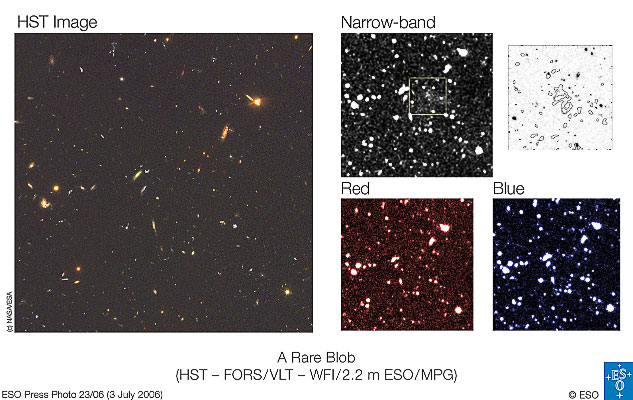
According to press materials, ESO's VLT has helped scientists to discover a large primordial 'blob', more than 10 billion light-years away. The most likely scenario to account for its existence and properties is that it represents the early stage in the formation of a galaxy, when gas falls onto a large clump of dark matter.

[ESO is the intergovernmental European research organisation for Astronomy in the Southern Hemisphere. It is supported by Belgium, Denmark, Finland, France, Germany, Italy, the Netherlands, Portugal, Sweden, Switzerland and the United Kingdom. VLT stands for very large telescope.]

Over the last few years, astronomers have discovered in the distant Universe a few so-called 'blobs'. These are rather energetic but under-luminous objects, of the size of or much larger than our Milky Way galaxy. Their exact nature is still unclear and several scenarios have been proposed to account for their existence.

An international team of astronomers have discovered a new 'blob' located at a distance of 11.6 billion light-years. It is thus seen as it was when the Universe was only 2 billion years old, or less than 15 percent its present age. The newly discovered object is located in the well-studied GOODS South field.

The blob is twice as big as our Milky Way and the total energy emitted is equivalent to that of about 2 billion suns. Despite this, the object is invisible in the images taken with various telescopes observing from the infrared to the X-ray wavebands, making it a very peculiar object. It is also the only such object found by the astronomers in their survey.

The research has been presented in a Letter to the Editor in the journal Astronomy and Astrophysics. To see spectacular photos visit this site.

Friday, June 30, 2006

Buffett gives Gates Foundation his wealth

What can I say - this news [in the Washington Post] gives me chills - the good kind:

"Investment guru Warren Buffett, whose stake in the company he founded is worth $44 billion, disclosed plans to give nearly all of it away, mostly to the world's largest charitable organization, the Bill & Melinda Gates Foundation.

"That revelation in Fortune magazine comes on the heels of Microsoft Corp. co-founder Bill Gates's announcement earlier this month that he would transition from running his company to running his foundation - and marks a golden age for philanthropic giving akin to that of a century ago, when industrialists such as Andrew Carnegie, John D. Rockefeller and Andrew W. Mellon gave vast amounts of their wealth to the arts and society."

Saturday, June 24, 2006

Electric signals - no wiring

New findings suggest that magnetic fields created using nanotechnology could make computers up to 500 times more powerful, if new research is successful.

The University of Bath is to lead an international £555,000 three-year project to develop a system which could cut out the need for wiring to carry electric currents in silicon chips.

Computers double in power every 18 months or so as scientists and engineers develop ways to make silicon chips smaller. But in the next few years they will hit a limit imposed by the need to use electric wiring, which weakens signals sent between computer components at high speed.

The new research project could produce a way of carrying electric signal without the need for wiring. Wi fi internet systems and mobile phones use wireless technology now, but the electronics that create and use wireless signals are too large to be used within individual microchips successfully.

The research project, which involves four universities in the UK and a university and research centre in Belgium and France, will look at ways of producing microwave energy on a small scale by firing electrons into magnetic fields produced in semi-conductors that are only a few atoms wide and are layered with magnets.

The process, called inverse electron spin resonance, uses the magnetic field to deflect electrons and to modify their magnetic direction. This creates oscillations of the electrons which makes them produce microwave energy. This can then be used to broadcast electric signals in free space without the weakening caused by wires.

Saturday, June 10, 2006

Vaccine for cervical cancer: behind the scenes

I am intrigued by the presentation of this research in this press release on Eurekalert!

"Creation of a successful vaccine against cervical cancer, approved today by the U.S. Food and Drug Administration, is the culmination of research that occurred thanks not only to scientists and physicians, but also to generous farmers and veterinarians, priests and nuns willing to tell all – and some very patient cows. At the University of Rochester Medical Center, the initial research more than 20 years ago included visits to veterinarians and meat-packaging plants in Upstate New York to collect scrapings from "prized" cow warts, and surveys of people unlikely to be infected with a sexually transmitted disease – priests and nuns who had taken a vow of celibacy. The work with the cows, the warts, the nuns and the priests illustrates how basic research can pay off in big and unexpected ways.

Will scoring improve in World Cup with new ball?

I enjoyed the stories in the news about the new football that is being used in the World Cup, so I am posting a press release from the University of Bath.

"The new football that will be used for the first time in the World Cup’s opening game on Friday (9 June 2006) is likely to bamboozle goalkeepers at some stage of the tournament, a leading scientist has warned.

The Adidas ‘Teamgeist’ football has just 14 panels - with fewer seams - making its surface ‘smoother’ than conventional footballs which have a 26 or 32 panel hexagon-based pattern.

This makes it aerodynamically closer to a baseball and, when hit with a slow spin, will make the ball less stable, giving it a more unpredictable trajectory in flight.

“With a very low spin rate, which occasionally happens in football, the panel pattern can have a big influence on the trajectory of the ball and make it more unpredictable for a goalkeeper,” said Dr Ken Bray, a sports scientist at the University of Bath and author of the new popular science book How to score – science and the beautiful game.

“Because the Teamgeist ball has just 14 panels it is aerodynamically more similar to the baseball which only has two panels.

“In baseball, pitchers often throw a ’curve ball’ which is similar to a swerving free kick and the rotating seam disrupts the air flow around the ball in much the same way as a football does.
“Occasionally though, pitchers will throw a ’knuckleball’ which bobs about randomly in flight and is very disconcerting for batters.

“It happens because pitchers throw the ball with very little spin and as the ball rotates lazily in the air, the seam disrupts the air flow around the ball at certain points on the surface, causing an unpredictable deflection.

“With the world’s best players in Germany this summer, there are bound to be plenty of spectacular scoring free kicks.

“But watch the slow motion replays to spot the rare occasions where the ball produces little or no rotation and where goalkeepers will frantically attempt to keep up with the ball’s chaotic flight path.”

The ball, which has been used by teams competing in the World Cup in practice sessions, has already been criticised by England goalkeeper Paul Robinson and Germany goalkeeper Jens Lehmann for its light-weight and unpredictable behaviour.

Sunday, June 04, 2006

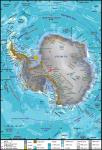
Crater beneath Antarctic linked to meteor

A new study press release planetary scientists have found evidence of a meteor impact much larger and earlier than the one that killed the dinosaurs - an impact that they believe caused the biggest mass extinction in Earth's history.

The 300-mile-wide crater lies hidden more than a mile beneath the East Antarctic Ice Sheet. And the gravity measurements that reveal its existence suggest that it could date back about 250 million years - the time of the Permian-Triassic extinction, when almost all animal life on Earth died out.

Its size and location - in the Wilkes Land region of East Antarctica, south of Australia - also suggest that it could have begun the breakup of the Gondwana supercontinent by creating the tectonic rift that pushed Australia northward.

Read more about this facinating discovery by Ohio State University researchers.

Saturday, June 03, 2006

Brain and computer chips advance

For the first time, scientists at the Max-Planck Institute for Biochemistry coupled living brain tissue to a chip equivalent to the chips that run computers, according to a report inJournal of Neurophysiology.

The scientists developed a revolutionary noninvasive technique that enables them to record neural communication between thousands of nervecells in the tissue of a brain slice with high spatial resolution. This technique involves culturing razor-thin slices of the hippocampus region on semiconductor chips.

The biophysicists were able to visualize the influence of pharmaceutical compounds on the neural network. This makes the “brain-chip” a novel test system for brain and drug research.