Thursday, August 03, 2006

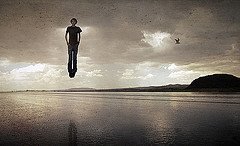
Maybe it is because I want to float...


Here you go - still pointing to some intriguing photography - I keep coming back to antimethod.
Wednesday, August 02, 2006

Open-source science - can you dig it?

According to a story from Chemical and Engineering News, "Scientists from Sydney to San Francisco have created an online research collaboration to develop cures for tropical diseases, using the 'open source' programming model that produced freeware like Linux and Firefox, the award-winning Web browser.

The motivation is straightforward: Tropical diseases are low priority for big pharma because the return on drug development is so small. Patients in developing nations just don't have the financial ability to pay for patented drugs.

The structure is radical: Online discussions will prioritize a list of experiments that anyone can take on. Raw data will be posted online and discussed. Members of the consortium will solicit further ideas and expertise, hoping the greater research community steps up to the plate.

The group, which operates under an umbrella website called Synaptic Leap, hopes that volunteered time, computer power, and reagents will eventually result in a portfolio of drug leads that will be made freely available for development. Currently, members of Synaptic Leap are describing projects online and asking others for help and advice.

Participants in open-source collaborations give up their ability to patent discoveries by definition, because their data are public as soon as they are posted. But some argue that when it comes to neglected diseases, there's nothing to lose, because there was never any income to gain."

Sunday, July 30, 2006

Looking at beauty in the city at night


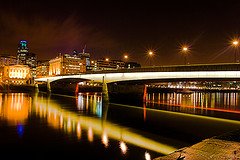
Okay - so this is off the medical beat, but I am so enamored of the beautiful photography on flickr ... here is Kayode Okeyode with some London photos.

Tuesday, July 25, 2006

Photos of the earth

To view beautiful photographs of our earth - go to tricky (sovietyuk).

Saturday, July 22, 2006

A fun experiment with water bed testing

Watch this hilarious video on Google videos - the water bed.

Thursday, July 20, 2006

Does BMI really count for all?

This is the kind of report that you want to say "of course I pretty much figured this" - this is something intuitive.
For years doctors have used the body mass index (BMI), a ratio of height and weight, to characterize the clinical weight status of their patients. The lower the number, the presumption goes, the leaner the person, and anyone with a BMI above 30 is characterized as obese and at high risk for the associated complications.

But the BMI has come under scrutiny lately, and other techniques that measure how the weight is distributed on the body are thought to provide a better way to assess risk. Now a study in mice by scientists at The Jackson Laboratory indicates that the usefulness of the BMI is suspect even at the genetic level.

In research published in PLoS Genetics, researchers used a combination of computational, molecular, and genetic tools to identify locations on the mouse genome that influence adiposity (amount of body fat), overall body size and bone structure. Applying an analytical technique called "structural equation modeling" to the genetic and physical characteristics of mouse inbred crosses, the scientists went beyond the one-gene, one-trait approach to reveal the networks of effects created by the influence of multiple genes.

The scientists say they found strong evidence that a high weight is not necessarily directly associated with a high percentage of fat.

At the clinical level, the research suggests that more refined measurements are needed to distinguish individuals with a large body mass from those who are truly obese.

Monday, July 17, 2006

Nanowires coaxed from bacteria and bioengeering electrical devices

This is pretty amazing to think about!

When Yuri Gorby discovered that a microbe which transforms toxic metals can sprout tiny electrically conductive wires from its cell membrane, he reasoned this anatomical oddity and its metal-changing physiology must be related.

A colleague who had heard Gorby's presentation at a scientific meeting later reported that he, too, was able to coax nanowires from another so-called metal-reducing bacteria species and futher suggested the wires, called pili, could be used to bioengineer electrical devices.

It now turns out that not only are the wires and their ability to alter metal connected--but that many other bacteria, including species involved in fermentation and photosynthesis, can also form wires under a variety of environmental conditions.

"Earth appears to be hard-wired," said Gorby, staff scientist at the Department of Energy's Proceedings of the National Academy of Science.

Tuesday, July 04, 2006

Developing galaxy an under-luminous blob

On occasion it is fun to look outward to the stars and far beyond - today's story is about ever-developing galaxies.

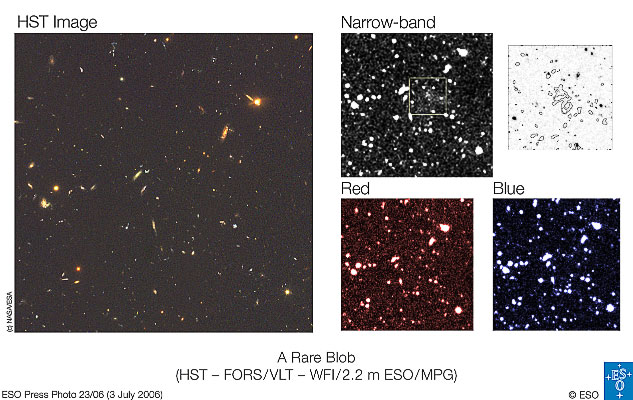
According to press materials, ESO's VLT has helped scientists to discover a large primordial 'blob', more than 10 billion light-years away. The most likely scenario to account for its existence and properties is that it represents the early stage in the formation of a galaxy, when gas falls onto a large clump of dark matter.

[ESO is the intergovernmental European research organisation for Astronomy in the Southern Hemisphere. It is supported by Belgium, Denmark, Finland, France, Germany, Italy, the Netherlands, Portugal, Sweden, Switzerland and the United Kingdom. VLT stands for very large telescope.]

Over the last few years, astronomers have discovered in the distant Universe a few so-called 'blobs'. These are rather energetic but under-luminous objects, of the size of or much larger than our Milky Way galaxy. Their exact nature is still unclear and several scenarios have been proposed to account for their existence.

An international team of astronomers have discovered a new 'blob' located at a distance of 11.6 billion light-years. It is thus seen as it was when the Universe was only 2 billion years old, or less than 15 percent its present age. The newly discovered object is located in the well-studied GOODS South field.

The blob is twice as big as our Milky Way and the total energy emitted is equivalent to that of about 2 billion suns. Despite this, the object is invisible in the images taken with various telescopes observing from the infrared to the X-ray wavebands, making it a very peculiar object. It is also the only such object found by the astronomers in their survey.

The research has been presented in a Letter to the Editor in the journal Astronomy and Astrophysics. To see spectacular photos visit this site.

Friday, June 30, 2006

Buffett gives Gates Foundation his wealth

What can I say - this news [in the Washington Post] gives me chills - the good kind:
"Investment guru Warren Buffett, whose stake in the company he founded is worth $44 billion, disclosed plans to give nearly all of it away, mostly to the world's largest charitable organization, the Bill & Melinda Gates Foundation.

"That revelation in Fortune magazine comes on the heels of Microsoft Corp. co-founder Bill Gates's announcement earlier this month that he would transition from running his company to running his foundation - and marks a golden age for philanthropic giving akin to that of a century ago, when industrialists such as Andrew Carnegie, John D. Rockefeller and Andrew W. Mellon gave vast amounts of their wealth to the arts and society."

Saturday, June 24, 2006

Electric signals - no wiring

New findings suggest that magnetic fields created using nanotechnology could make computers up to 500 times more powerful, if new research is successful.

The University of Bath is to lead an international £555,000 three-year project to develop a system which could cut out the need for wiring to carry electric currents in silicon chips.

Computers double in power every 18 months or so as scientists and engineers develop ways to make silicon chips smaller. But in the next few years they will hit a limit imposed by the need to use electric wiring, which weakens signals sent between computer components at high speed.

The new research project could produce a way of carrying electric signal without the need for wiring. Wi fi internet systems and mobile phones use wireless technology now, but the electronics that create and use wireless signals are too large to be used within individual microchips successfully.

The research project, which involves four universities in the UK and a university and research centre in Belgium and France, will look at ways of producing microwave energy on a small scale by firing electrons into magnetic fields produced in semi-conductors that are only a few atoms wide and are layered with magnets.

The process, called inverse electron spin resonance, uses the magnetic field to deflect electrons and to modify their magnetic direction. This creates oscillations of the electrons which makes them produce microwave energy. This can then be used to broadcast electric signals in free space without the weakening caused by wires.

Saturday, June 10, 2006

Vaccine for cervical cancer: behind the scenes

I am intrigued by the presentation of this research in this press release on Eurekalert!

"Creation of a successful vaccine against cervical cancer, approved today by the U.S. Food and Drug Administration, is the culmination of research that occurred thanks not only to scientists and physicians, but also to generous farmers and veterinarians, priests and nuns willing to tell all – and some very patient cows. At the University of Rochester Medical Center, the initial research more than 20 years ago included visits to veterinarians and meat-packaging plants in Upstate New York to collect scrapings from "prized" cow warts, and surveys of people unlikely to be infected with a sexually transmitted disease – priests and nuns who had taken a vow of celibacy. The work with the cows, the warts, the nuns and the priests illustrates how basic research can pay off in big and unexpected ways.

Will scoring improve in World Cup with new ball?

I enjoyed the stories in the news about the new football that is being used in the World Cup, so I am posting a press release from the University of Bath.
"The new football that will be used for the first time in the World Cup’s opening game on Friday (9 June 2006) is likely to bamboozle goalkeepers at some stage of the tournament, a leading scientist has warned.

The Adidas ‘Teamgeist’ football has just 14 panels - with fewer seams - making its surface ‘smoother’ than conventional footballs which have a 26 or 32 panel hexagon-based pattern.

This makes it aerodynamically closer to a baseball and, when hit with a slow spin, will make the ball less stable, giving it a more unpredictable trajectory in flight.

“With a very low spin rate, which occasionally happens in football, the panel pattern can have a big influence on the trajectory of the ball and make it more unpredictable for a goalkeeper,” said Dr Ken Bray, a sports scientist at the University of Bath and author of the new popular science book How to score – science and the beautiful game.

“Because the Teamgeist ball has just 14 panels it is aerodynamically more similar to the baseball which only has two panels.

“In baseball, pitchers often throw a ’curve ball’ which is similar to a swerving free kick and the rotating seam disrupts the air flow around the ball in much the same way as a football does.
“Occasionally though, pitchers will throw a ’knuckleball’ which bobs about randomly in flight and is very disconcerting for batters.

“It happens because pitchers throw the ball with very little spin and as the ball rotates lazily in the air, the seam disrupts the air flow around the ball at certain points on the surface, causing an unpredictable deflection.

“With the world’s best players in Germany this summer, there are bound to be plenty of spectacular scoring free kicks.

“But watch the slow motion replays to spot the rare occasions where the ball produces little or no rotation and where goalkeepers will frantically attempt to keep up with the ball’s chaotic flight path.”

The ball, which has been used by teams competing in the World Cup in practice sessions, has already been criticised by England goalkeeper Paul Robinson and Germany goalkeeper Jens Lehmann for its light-weight and unpredictable behaviour.

Sunday, June 04, 2006

Crater beneath Antarctic linked to meteor

A new study press release planetary scientists have found evidence of a meteor impact much larger and earlier than the one that killed the dinosaurs - an impact that they believe caused the biggest mass extinction in Earth's history.
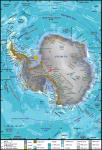
The 300-mile-wide crater lies hidden more than a mile beneath the East Antarctic Ice Sheet. And the gravity measurements that reveal its existence suggest that it could date back about 250 million years - the time of the Permian-Triassic extinction, when almost all animal life on Earth died out.

Its size and location - in the Wilkes Land region of East Antarctica, south of Australia - also suggest that it could have begun the breakup of the Gondwana supercontinent by creating the tectonic rift that pushed Australia northward.

Read more about this facinating discovery by Ohio State University researchers.

Saturday, June 03, 2006

Brain and computer chips advance

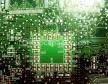
For the first time, scientists at the Max-Planck Institute for Biochemistry coupled living brain tissue to a chip equivalent to the chips that run computers, according to a report inJournal of Neurophysiology.

The scientists developed a revolutionary noninvasive technique that enables them to record neural communication between thousands of nervecells in the tissue of a brain slice with high spatial resolution. This technique involves culturing razor-thin slices of the hippocampus region on semiconductor chips.

The biophysicists were able to visualize the influence of pharmaceutical compounds on the neural network. This makes the “brain-chip” a novel test system for brain and drug research.

Saturday, May 27, 2006

Global warming getting attention

Watch the trailer for the new movie "An Inconvenient Truth," go to the movie, and decide for yourself if you want to make a commitment to addressing global warming. There are many ways to save the planet. Check out climatecrisis.net. Treehugger.com. EPA. Wikipedia on global warming. Global Warming.net. Watch global warming. New Scientist on climate change. Georgia Tech studies up.
Save the Internet: a bill for Network Neutrality

Today's news: A bipartisan majority on the House Judiciary Committee passed the "Internet Freedom and Nondiscrimination Act" - a good bill that would protect Network Neutrality and prohibit large phone and cable companies from turning the Internet into their private domain.
Yesterday's vote is a milestone in our campaign. It would have been unthinkable just four weeks ago - when we lost a vote on Net Neutrality in the House Energy and Commerce Committee.
In the weeks since that first vote, we have ignited a prairie fire across America. And Washington is beginning to feel the heat:

More than 700 groups from all 50 states are now a part of the SavetheInternet.com Coalition - a diverse list that includes MoveOn.org, the Christian Coalition, the Service Employees International Union (SEIU), Consumers Union and the American Library Association A-list musicians such as REM, Moby, The Roots and the Dixie Chicks have joined the coalition with many more to be announced soon.

Major U.S. newspapers have written editorials supporting our position. More than 5,000 bloggers have linked to the SavetheInternet.com Web site and blog - urging their readers to take action on this issue. And yesterday, the Coalition's petition drive surpassed 750,000 signatures. With little money and through the efforts of many, we have turned momentum against a handful of phone and cable giants that are spending untold millions of dollars to squash Internet freedom. But there is more work to do.

The full House will take up the bipartisan Judiciary bill in June. The Senate is also considering legislation that currently fails to protect Net Neutrality, though a bipartisan group of Senators are lining up behind an excellent bipartisan bill sponsored by Senators Olympia Snowe (R-Maine) and Byron Dorgan (D-North Dakota).

Stay tuned. Also read more on Wired - for an interesting story.

Thursday, May 25, 2006

MySpace meets Al Gore

According to Online Media Daily, former Vice President Al Gore and Paramount Classics today begin a broad partnership with MySpace to promote their climate change documentary, "An Inconvenient Truth."

"MySpace has a unique ability to mobilize its community around an urgent cause," Al Gore says.

MySpace's campaign for "An Inconvenient Truth" includes a custom-designed site where the community's more than 70 million registered members can meet and exchange ideas. Among other features, the page offers a "personal environmental impact calculator" for users to assess their personal contribution to global warming. The site also presents related facts and tips for reducing carbon emissions and living "green."

Wow - a fantastic use of MySpace!!

Wednesday, May 24, 2006

Points of light: gender and gait

Sometimes I like to comment on good writing in public relations for science, and this press release from Salk Institute captures my interest. Plus, the topic is intriguing and will make you think about your impressions of the gait of just about everyone you know!

It doesn't take John Wayne's deliberate, pigeon-toed swagger or Marilyn Monroe's famously wiggly sway to judge a person's gender based on the way they move. People are astonishingly accurate when asked to judge the gender of walking human figures, even when they are represented by 15 small dots of light attached to major joints of the body. And not only that, when human observers watched the walking motion of a male so-called "point light walker," they were more sensitive to the female attributes when watching the next figure in the sequence. This suggests that the human brain relies on specialized neurons that tell gender based on gait, report researchers at the Salk Institute for Biological Studies in the May 21 advance online edition of Nature Neuroscience.

Read more on Eurekalert.

Monday, May 22, 2006

Scientists' findings: levees during Katrina

Following an eight-month study of the New Orleans levee system and its performance during Hurricane Katrina, a 30-person team of researchers led by Raymond Seed and Robert Bea of the University of California, Berkeley, released a near-complete draft of their findings today in a "town hall" meeting in that Gulf Coast city.

Seed received two National Science Foundation grants to collect perishable data and to conduct an independent field investigation of the performance of the New Orleans levee systems with the intent the findings would prove vital for gauging the performance of levee systems distributed across the United States.

The levee study is one of more than 100 NSF supported in response to Hurricanes Katrina and Rita. For decades, the agency has supported field investigations following all manner of disasters, allowing researchers to travel the world to collect perishable data as soon as possible after an event. Read more.

Imagine whales on land - what once was

Researchers have revealed the genetic basis behind one of the best-documented examples of evolutionary change in the fossil record: how whales lost their hind limbs. Writing in this week's Proceedings of the National Academy of Sciences, scientists report that ancient whales - four-footed land animals not unlike large modern dogs - evolved into graceful, streamlined swimmers through a series of small genetic changes during the whales' embryonic development.

A gene called "Sonic Hedgehog," named by a creative scientist, was in effect between 41 million and 50 million years ago when whales' hind limbs shrank greatly as the former land animals began a return to the sea. But their legs showed no change in the basic arrangement and number of bones, which proved that Sonic Hedgehog was in effect. Read more great science findings at the National Science Foundation.